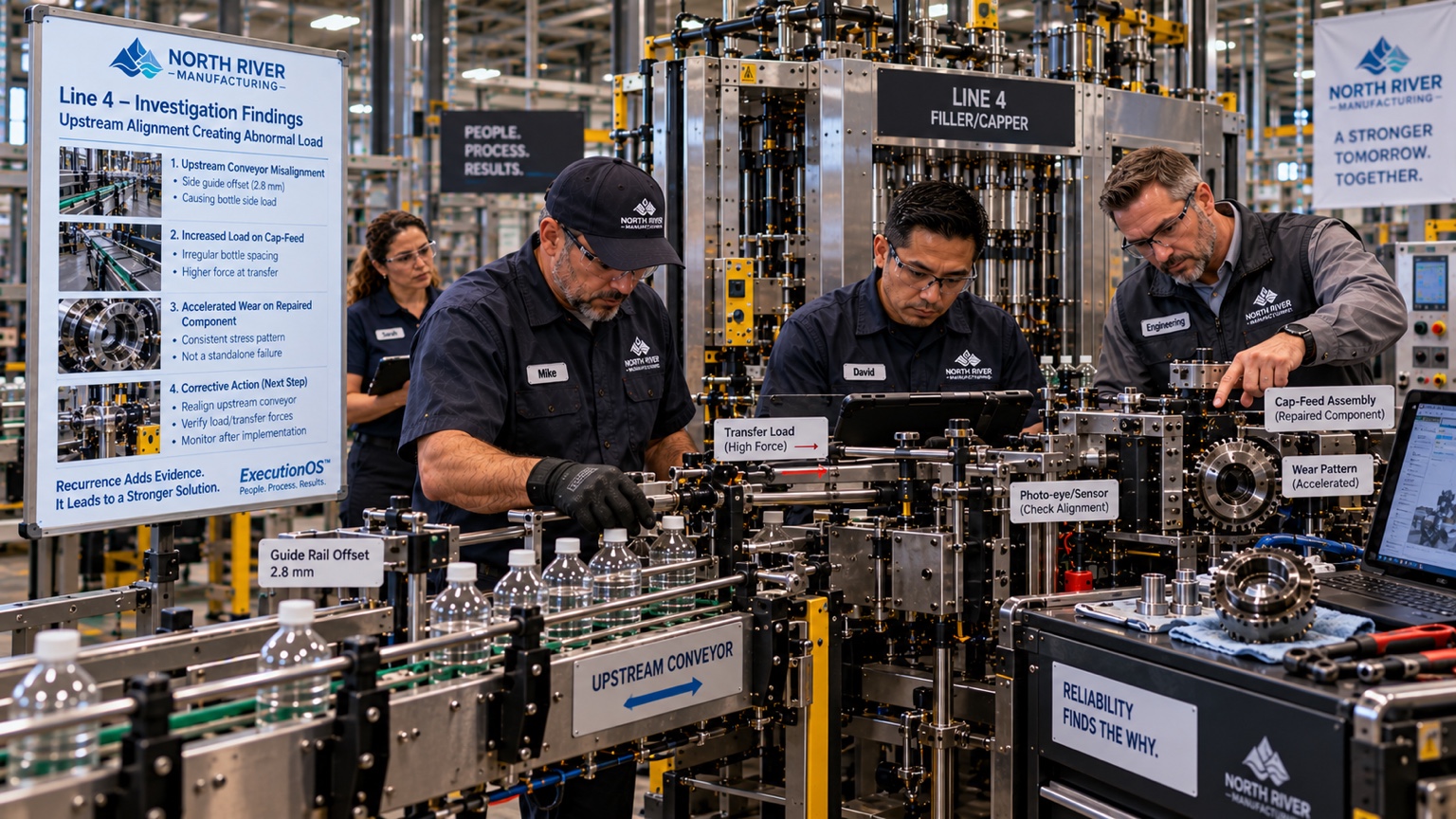
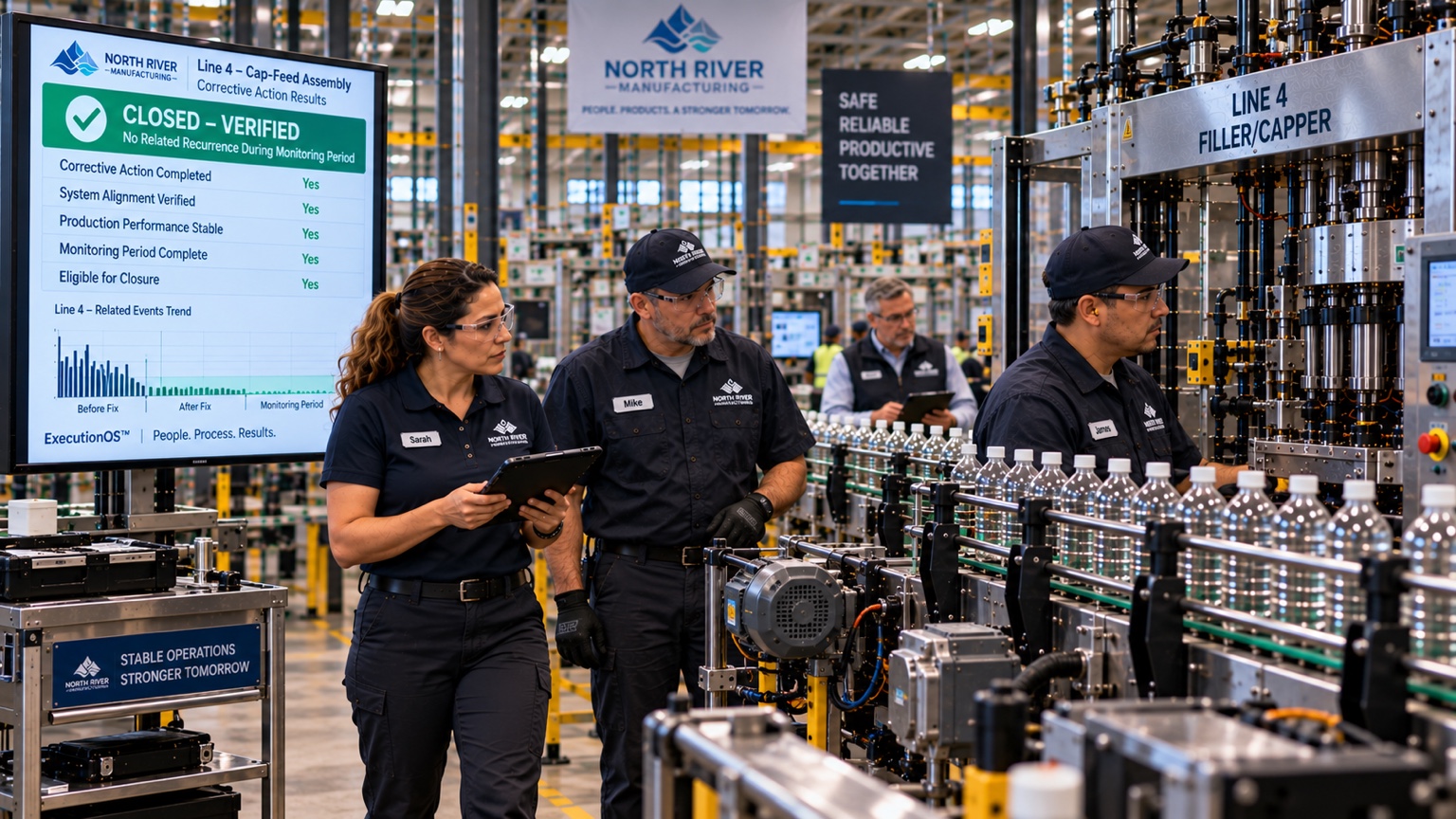
Recurrence Command Center
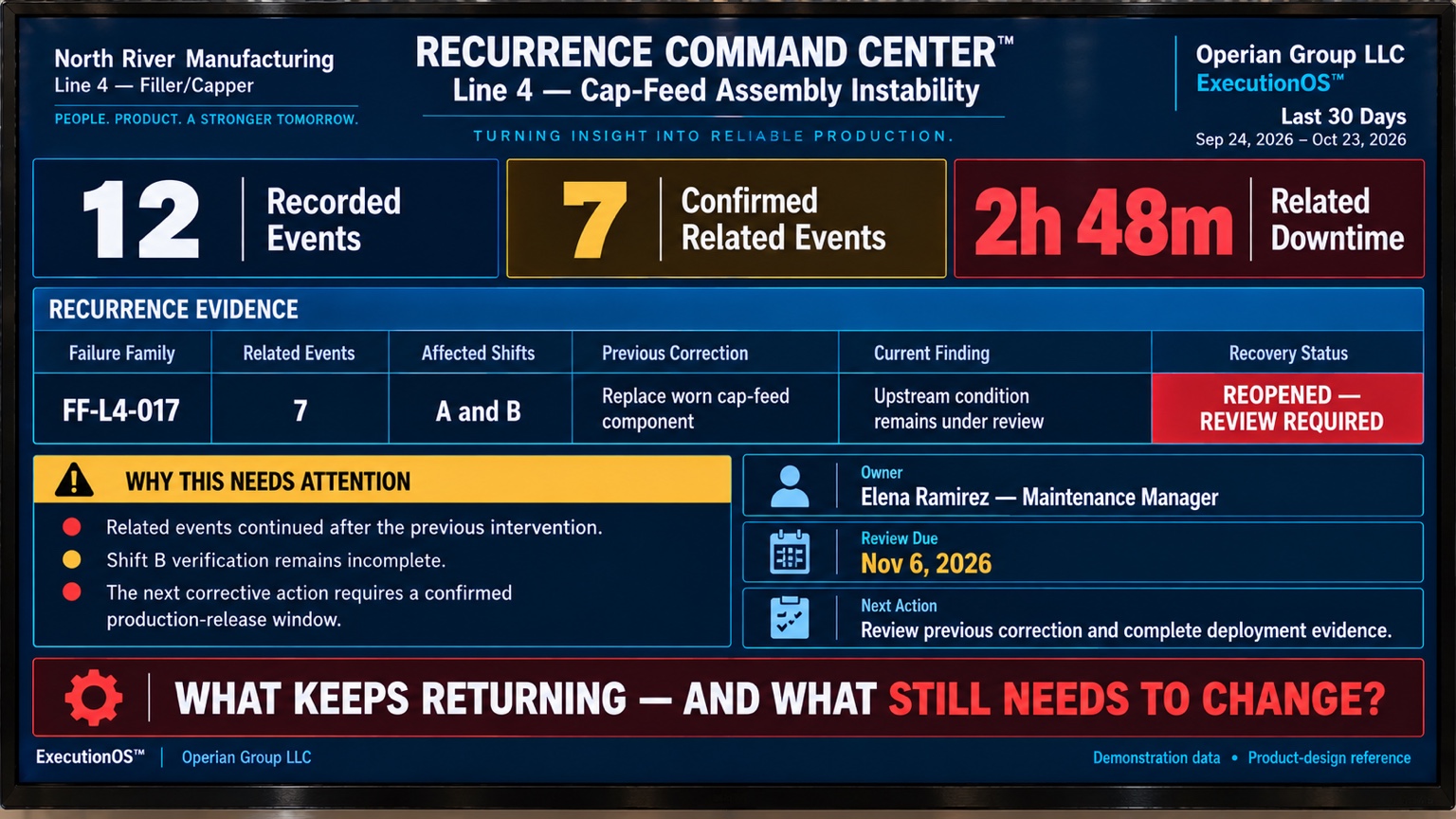
What keeps returning—and what still needs to change?
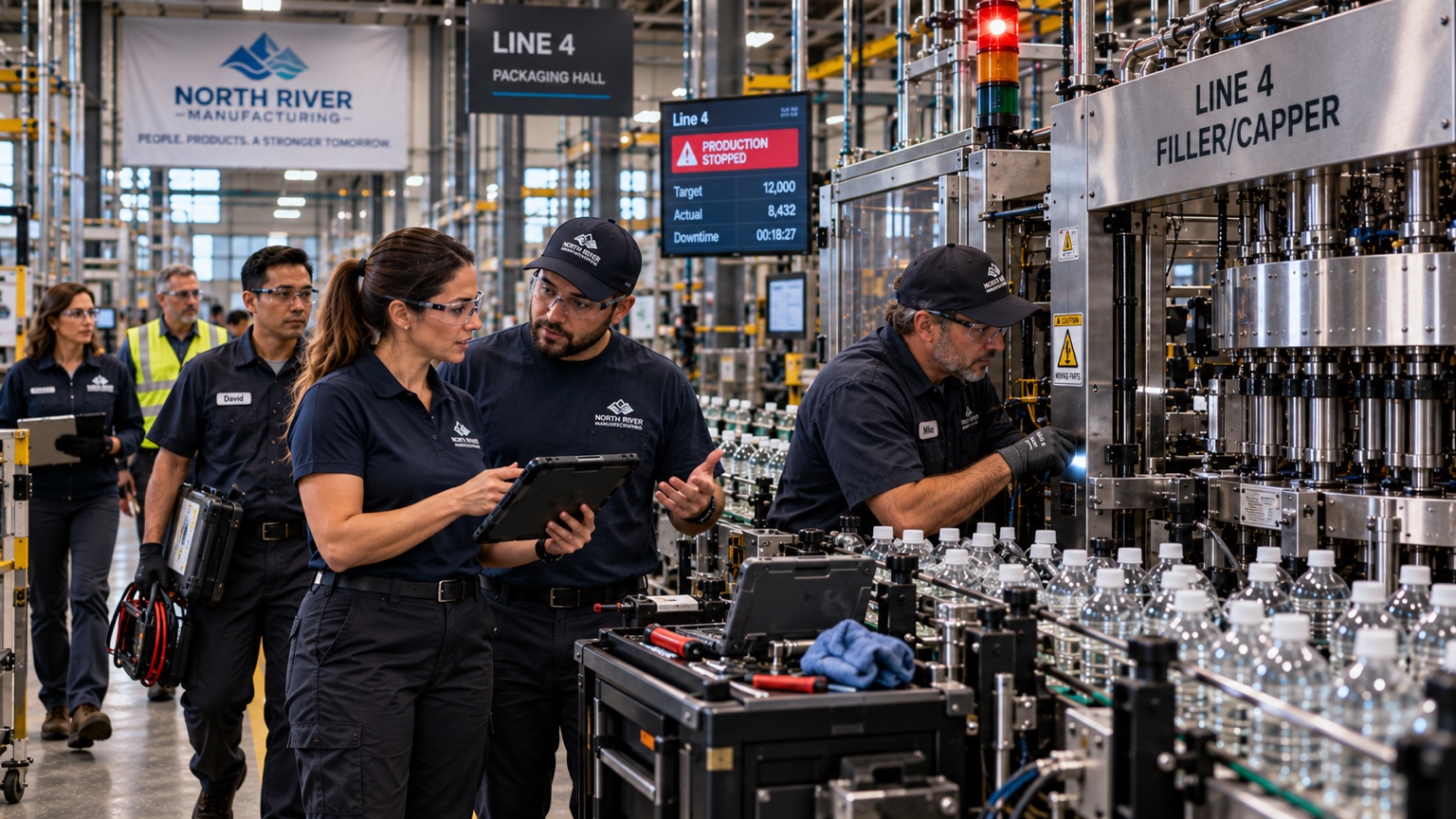
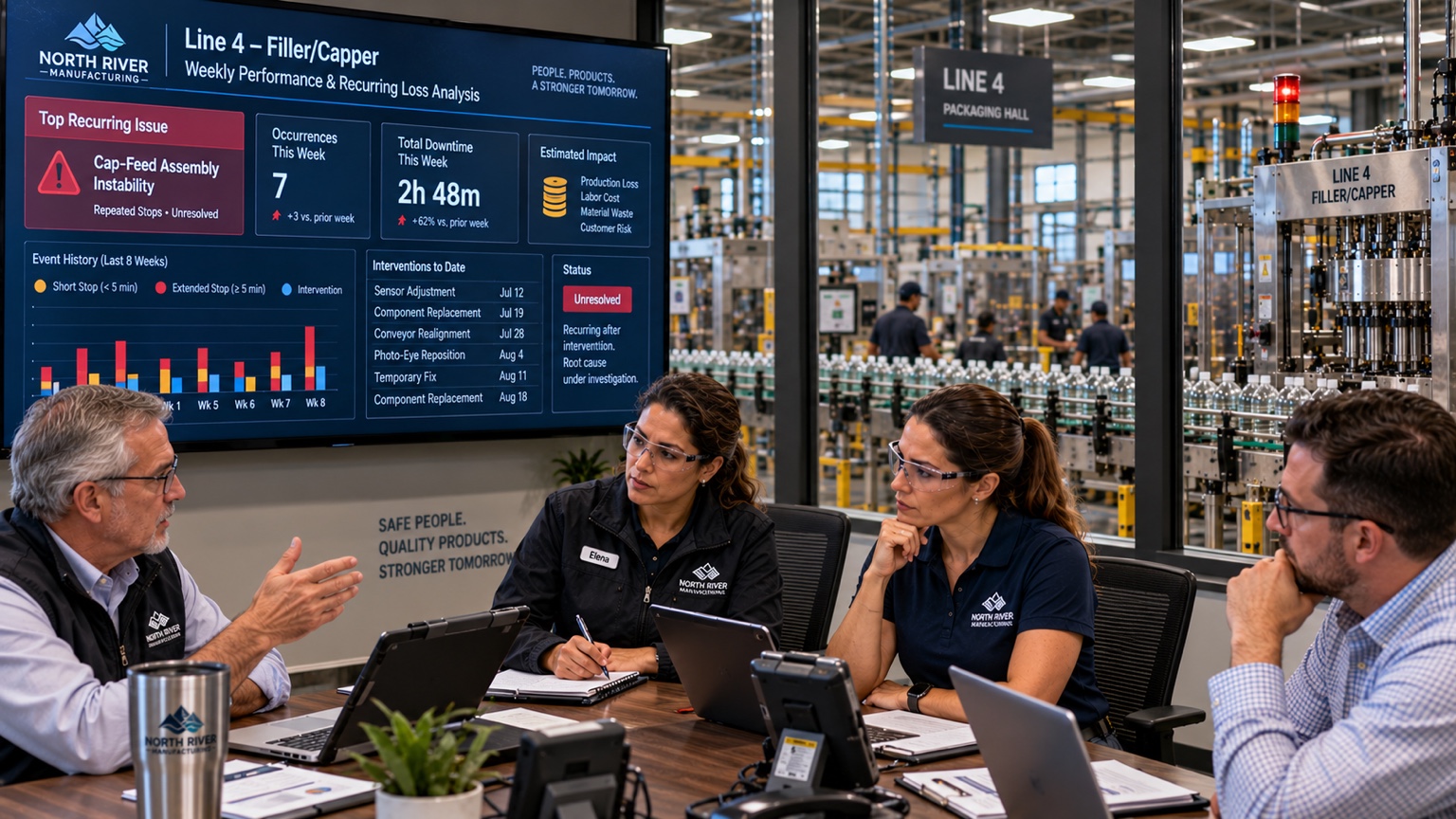
ExecutionOS is designed to bring related breakdowns into one operating view. Leaders can review recurring events, affected shifts, previous corrections, unresolved evidence and the next action needed to remove the loss. A repeated condition prompts review of both the repair and the way the correction was deployed.
Illustrative North River Manufacturing operating board. Demonstration data and product-design reference; not a customer result.
Explore the Recurrence Evidence
Recurrence Fingerprint
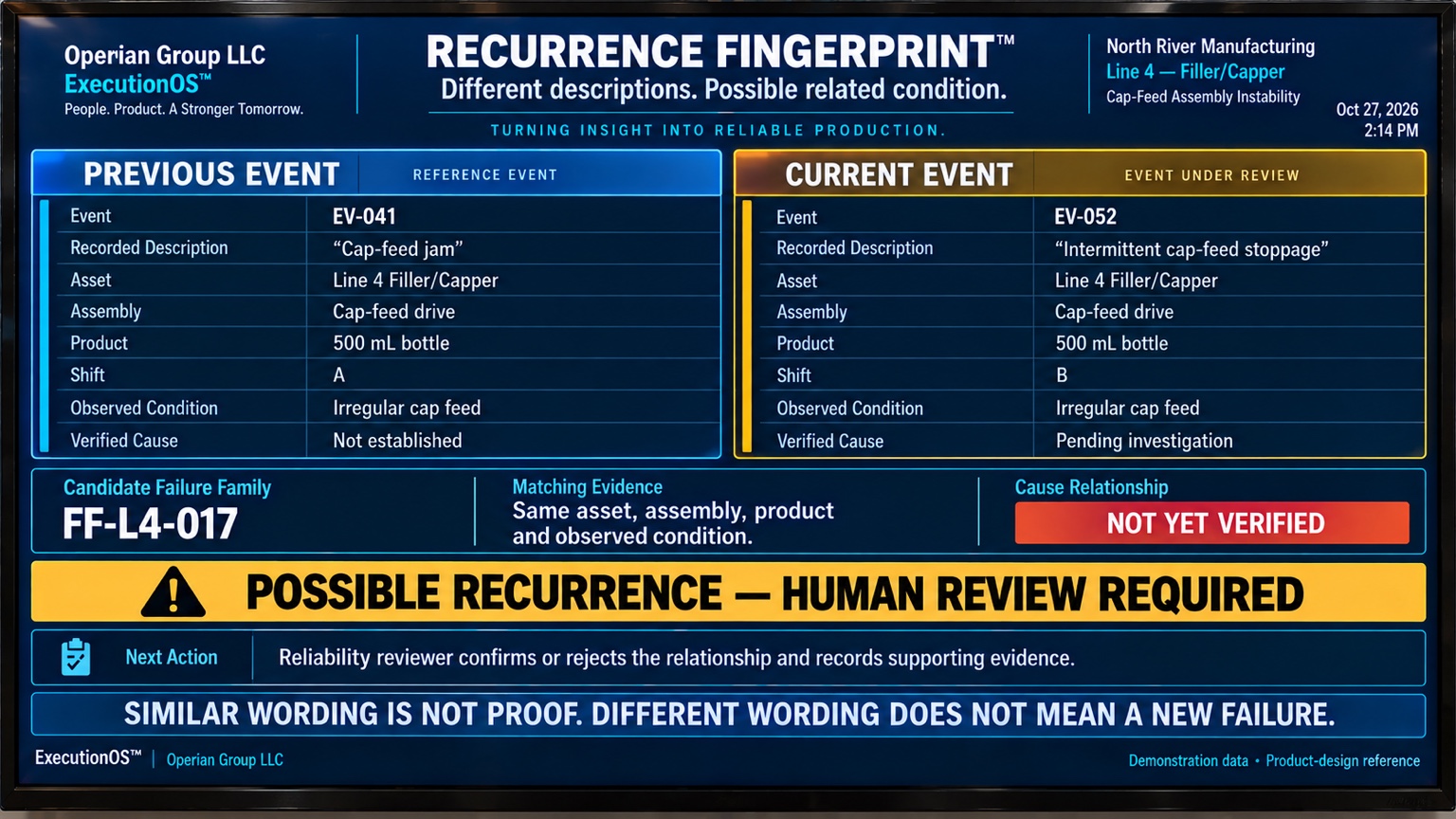
Different descriptions can belong to the same returning failure.
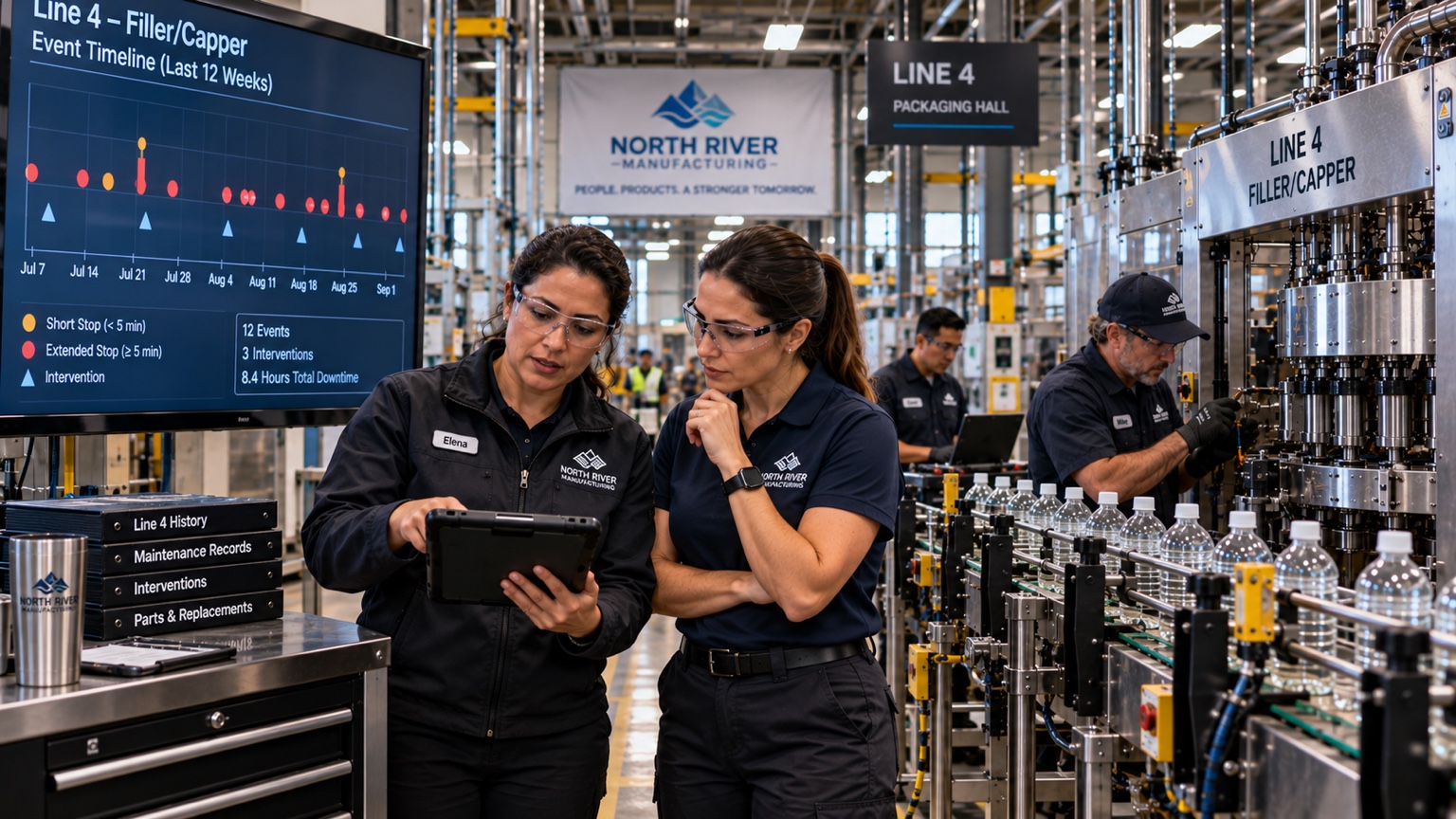
An operator may record a cap-feed jam while another shift reports intermittent stoppages. ExecutionOS is designed to compare the asset, assembly, product, observed condition and prior intervention so an authorized reviewer can determine whether the events belong to the same failure family. A possible match is evidence for review; it is not a verified cause.
Illustrative North River Manufacturing operating board. Demonstration data and product-design reference; not a customer result.
See How Related Events Are Reviewed
Deployment Control Tower
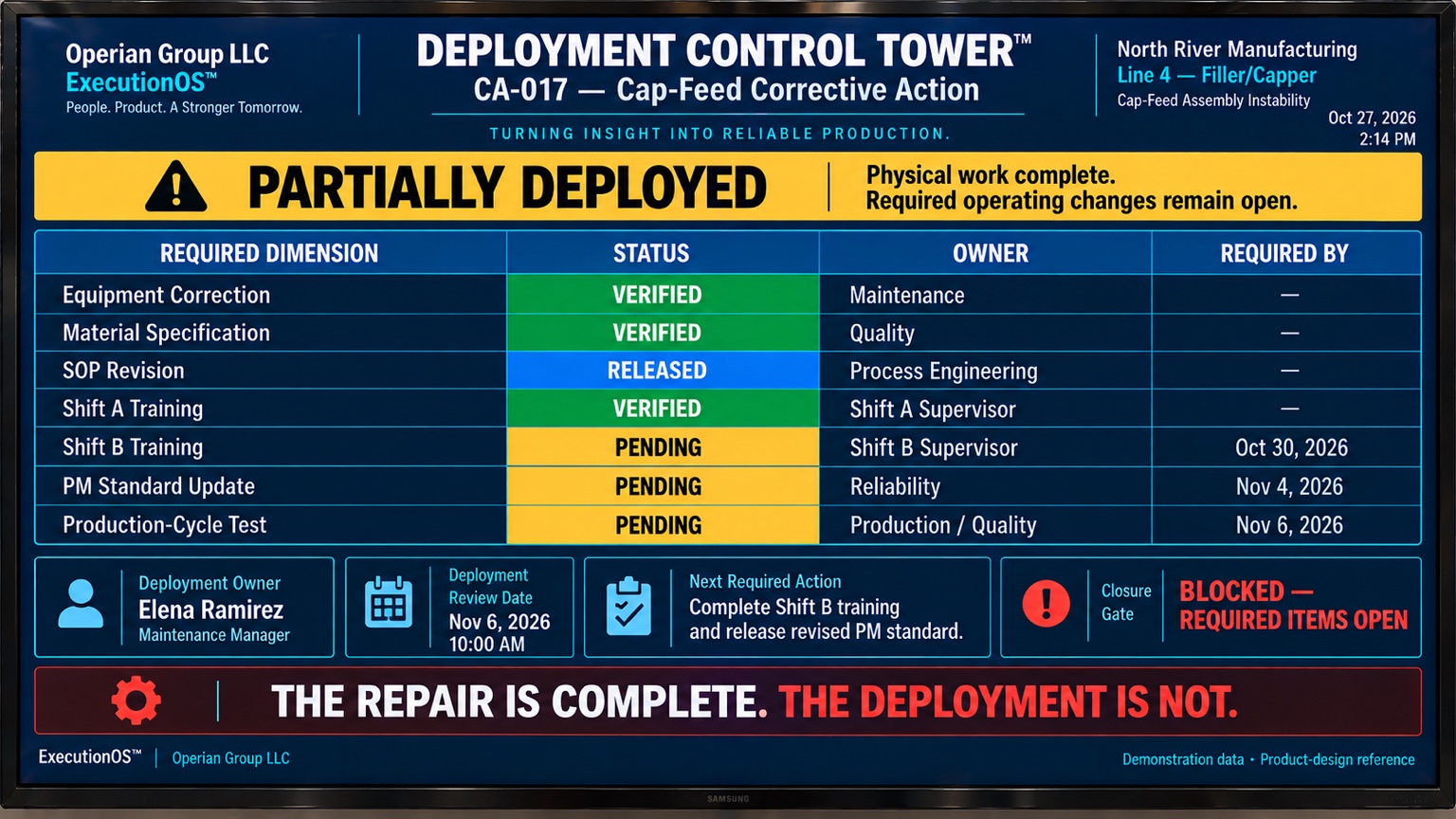
The repair is complete. The deployment is not.
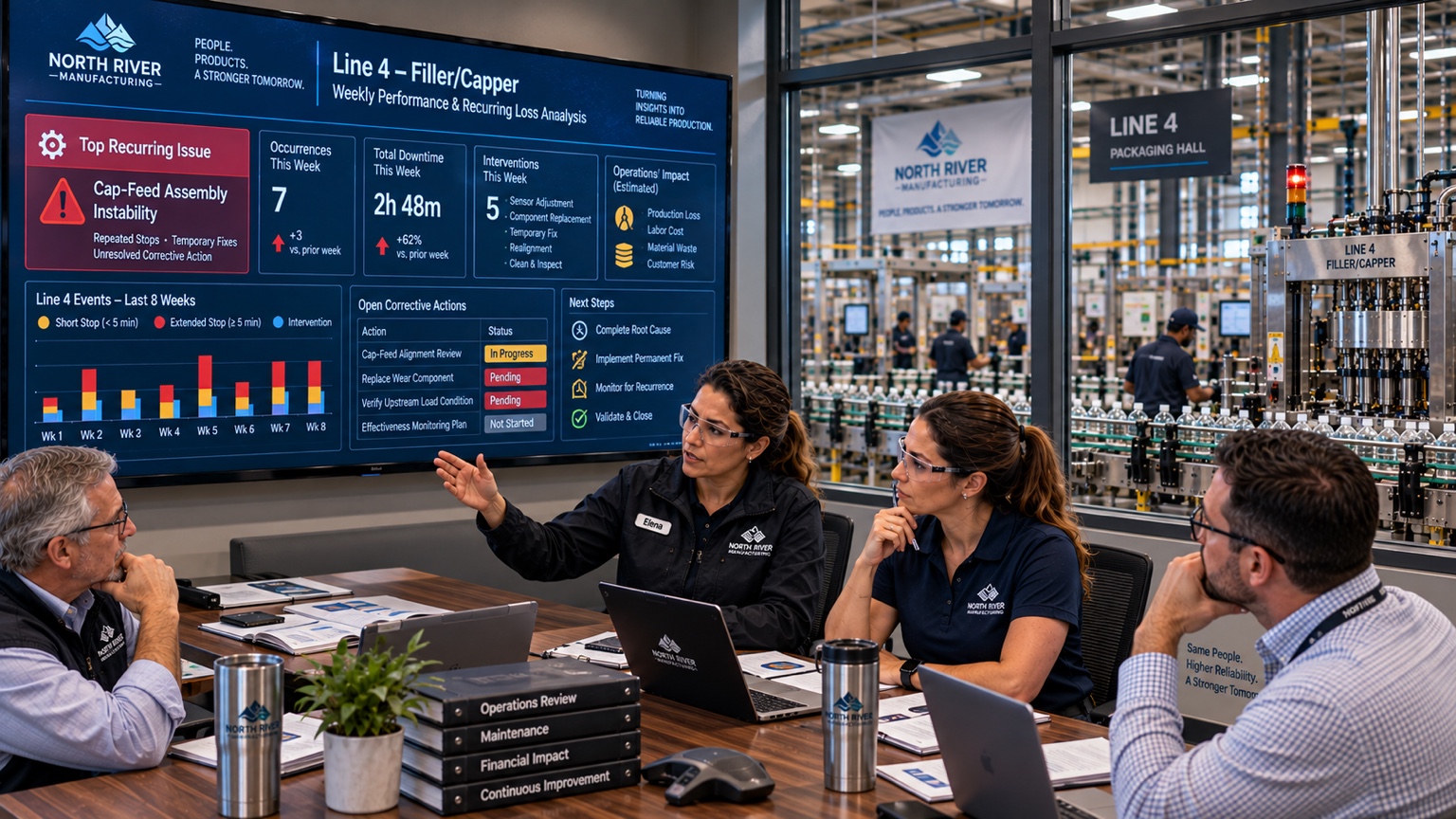
Replacing a component completes only part of a corrective plan. The Deployment Control Tower is designed to show whether training reached each affected shift, the revised SOP was released, the PM standard changed, and the required production-cycle test was verified. Required items remain visible until their evidence is complete.
Illustrative North River Manufacturing operating board. Demonstration data and product-design reference; not a customer result. Depicts pending shift training, PM update and production-cycle verification at one point in time — not final closure.
Review the Deployment Requirements
Deployment Breakdown Analysis
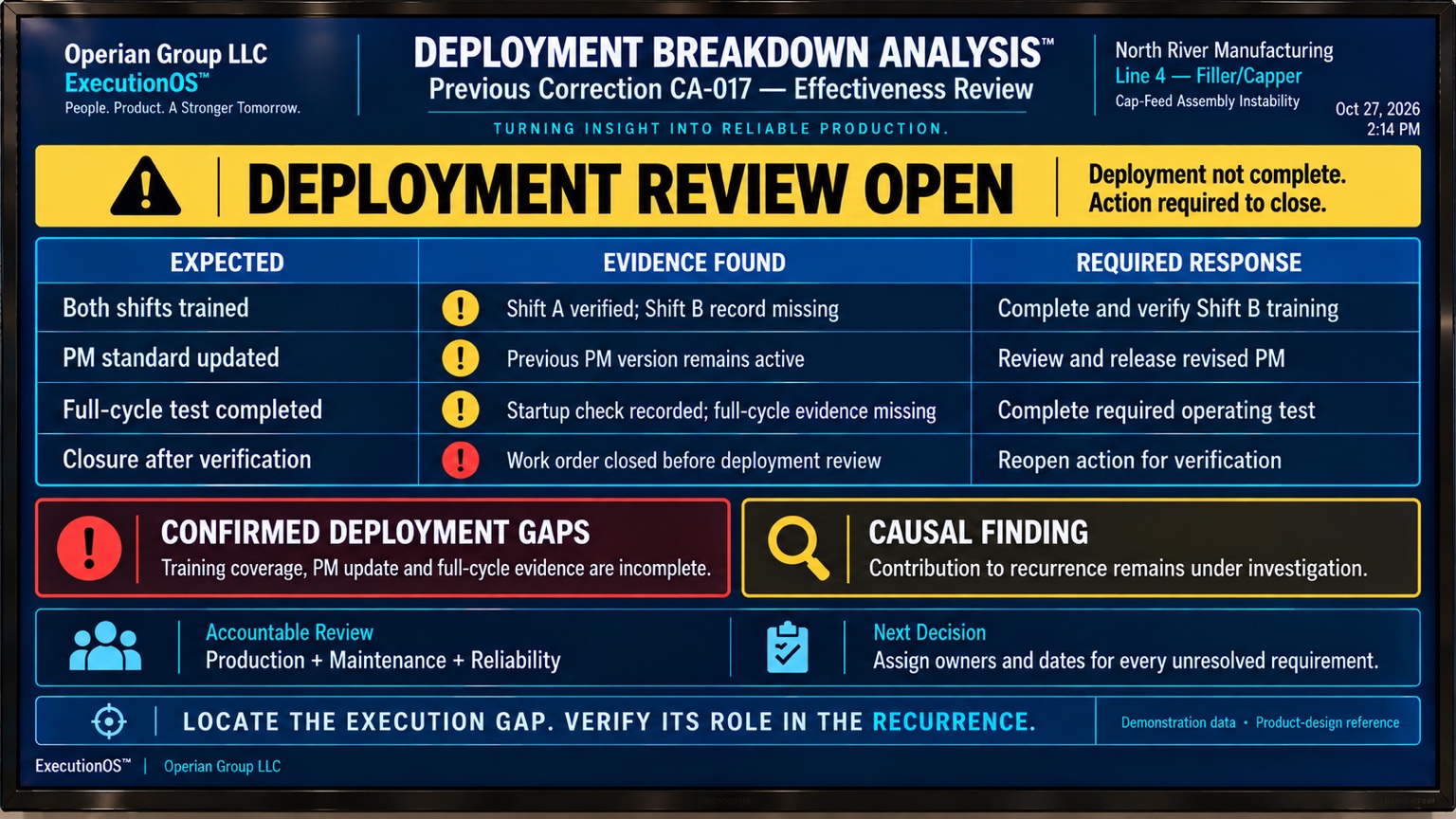
Find where the previous corrective plan stopped.
When a condition returns, compare the expected deployment with the evidence actually recorded. Missing training, an unchanged PM standard, or a skipped operating test may reveal an execution gap. Qualified reviewers must still determine whether that gap contributed to recurrence. The review preserves what is known, what remains uncertain, and who owns the next action.
Illustrative North River Manufacturing operating board. Demonstration data and product-design reference; not a customer result. Missing evidence is not automatically proof of cause.
Follow the Effectiveness Review
Recovery Ledger
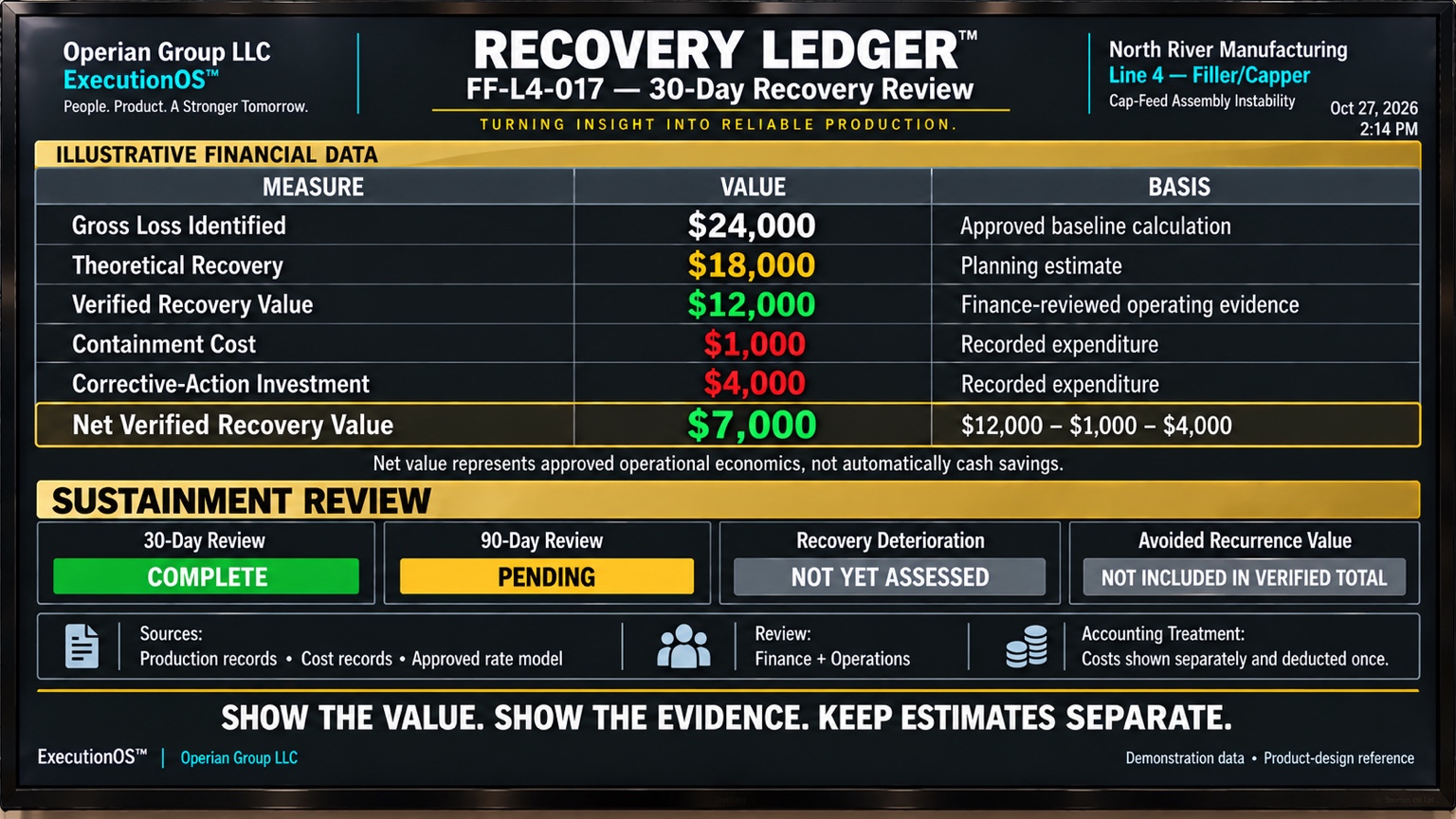
Show the recovered value—and the evidence behind it.
The Recovery Ledger is designed to distinguish identified loss, planning estimates, verified operational recovery, and the costs of containment and correction. Finance and Operations review the source records and assumptions. Sustained recovery remains a separate question: did the improvement hold, and did any of the expected value deteriorate?
Illustrative North River Manufacturing operating board. Demonstration data and product-design reference; not a customer result. Gross loss, theoretical recovery, operational capacity and avoided loss are shown separately and are not additive; net operational value is not automatically cash savings. A completed 30-day review does not establish 90-day sustainment.
Explore Recovery Verification
Ten Operian Metrics
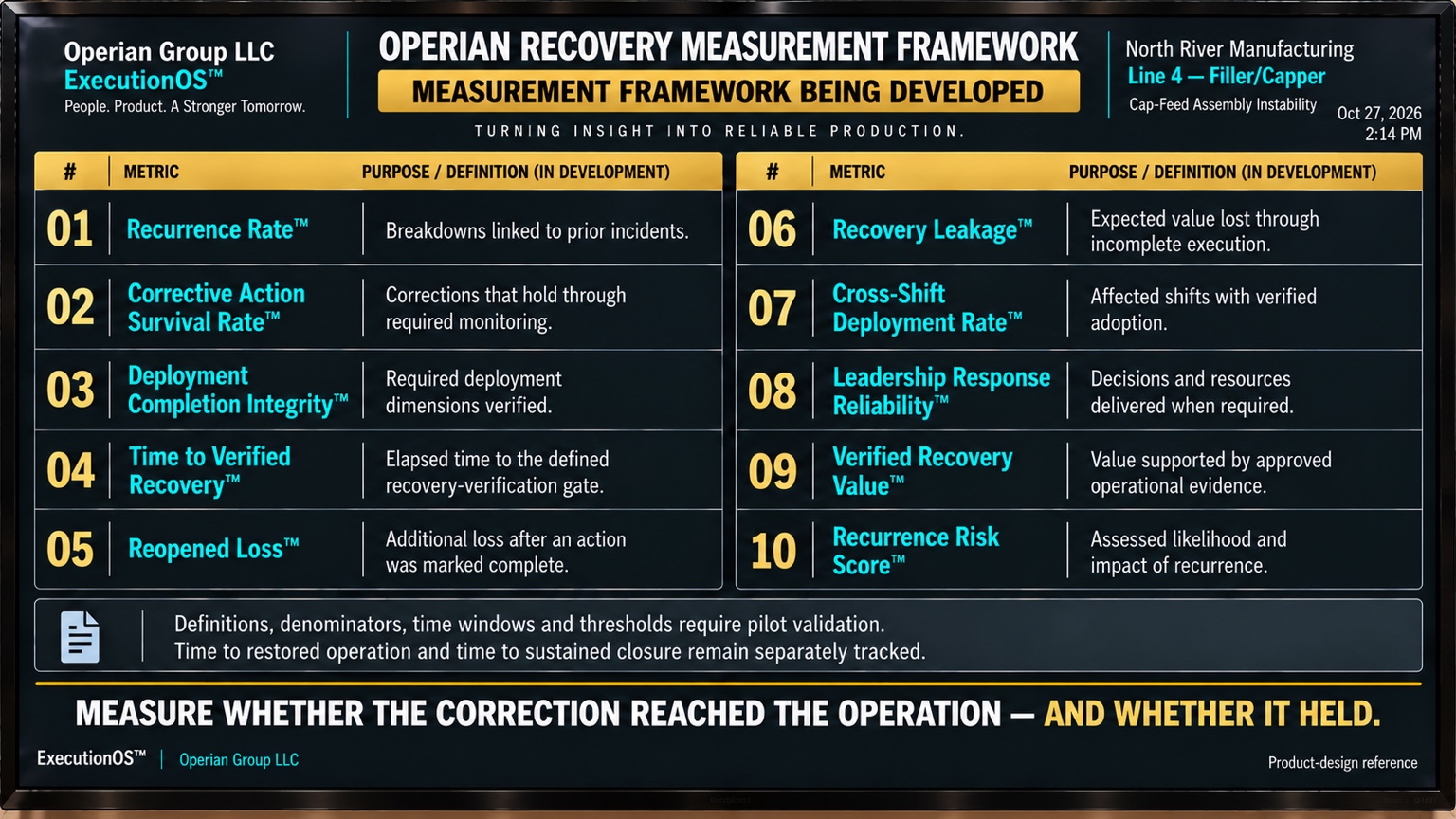
Measure whether the correction reached the operation—and whether it held.
ExecutionOS is developing a measurement framework for recurrence, deployment integrity, leadership response, verified recovery, and sustained correction. The framework complements operational measures such as downtime, OEE, MTTR and MTBF.
MEASUREMENT FRAMEWORK BEING DEVELOPED — definitions, measurement windows and thresholds require pilot validation before scores can be treated as established benchmarks.
Illustrative North River Manufacturing operating board. Demonstration data and product-design reference; not a customer result.
| Recurrence Rate™ | Share of reviewed breakdowns confirmed as related to a prior incident within a defined window. |
| Corrective Action Survival Rate™ | Share of corrections remaining effective through the required monitoring exposure; pending cases shown separately. |
| Deployment Completion Integrity™ | Completion and verification of all applicable required deployment dimensions, with critical missing gates visible. |
| Time to Verified Recovery™ | Elapsed time from the defined signal to the agreed recovery-verification gate; restoration and sustained closure timed separately. |
| Reopened Loss™ | Measured loss generated after an action was marked complete and a related condition returned. |
| Recovery Leakage™ | Expected recovery not realized due to evidenced execution shortfalls, distinct from forecast error or unrelated operating changes. |
| Cross-Shift Deployment Rate™ | Share of affected shifts with evidenced adoption, not merely a message sent. |
| Leadership Response Reliability™ | Whether required decisions, resources and escalations occurred by agreed deadlines. |
| Verified Recovery Value™ | Operational value supported by reviewed records and approved assumptions; cash savings and restored capacity are distinguished. |
| Recurrence Risk Score™ | A developing assessment of recurrence likelihood and consequence — not an established predictive probability. |
Discuss the Measurement Framework
Recurrence Check
Keep watching until the evidence supports closure.
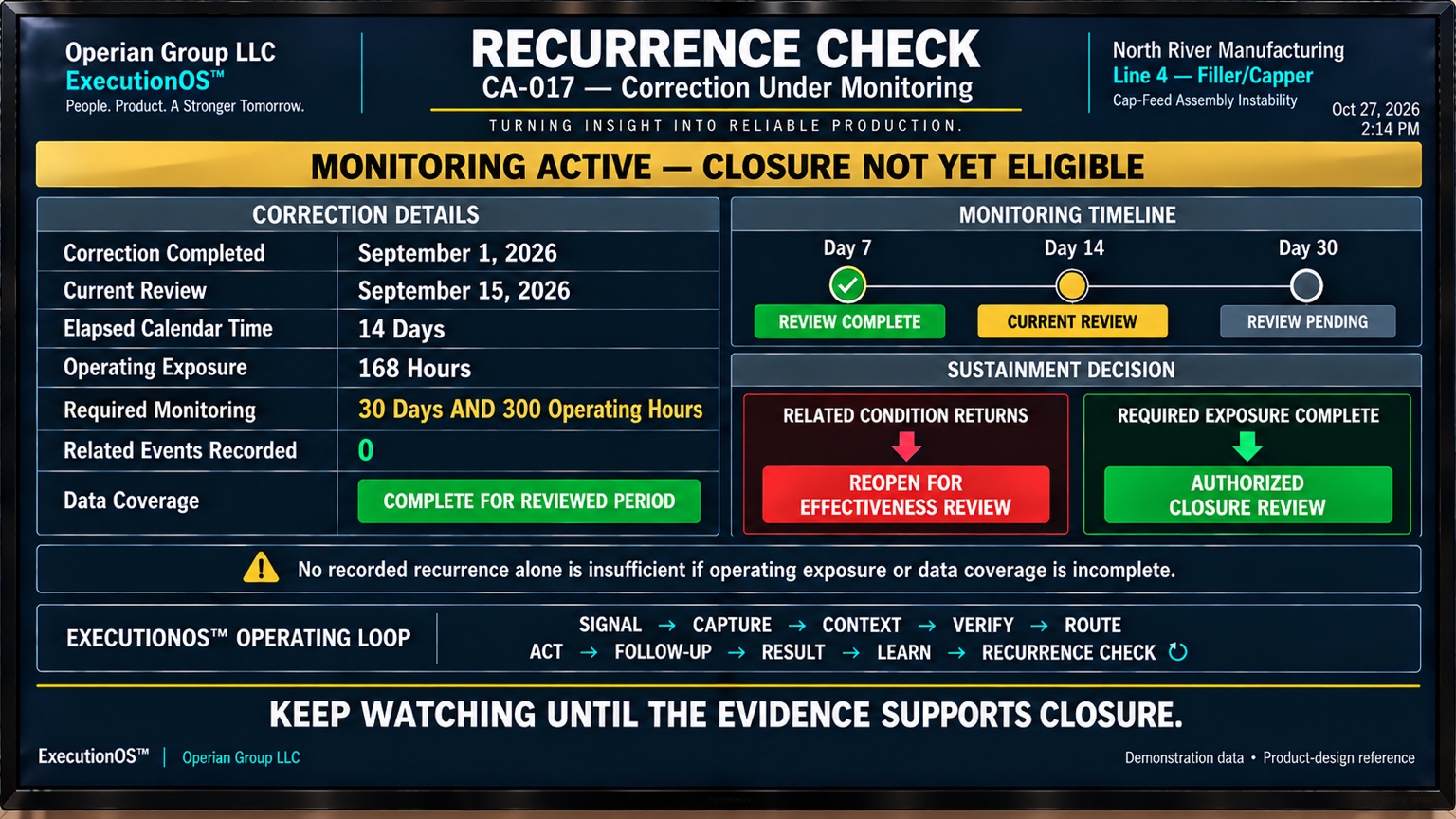
A period without recorded incidents does not prove that a correction held if the equipment did not run long enough or source data is incomplete. Recurrence Check is designed to track elapsed time, operating exposure, data coverage and related events against the agreed monitoring requirement. A returning condition triggers effectiveness review; completed monitoring allows an authorized closure review.
Illustrative North River Manufacturing operating board — historical review snapshot; demonstration data and product-design reference, not a customer result. Requires both 30 days and 300 operating hours of monitoring; 14 days / 168 hours with zero related events is not eligible for closure. Source coverage and authorized review remain required.
See the Closure Requirements (detail forthcoming)
Operational Deployment Assurance
The correction reached the operation. Now prove it holds.
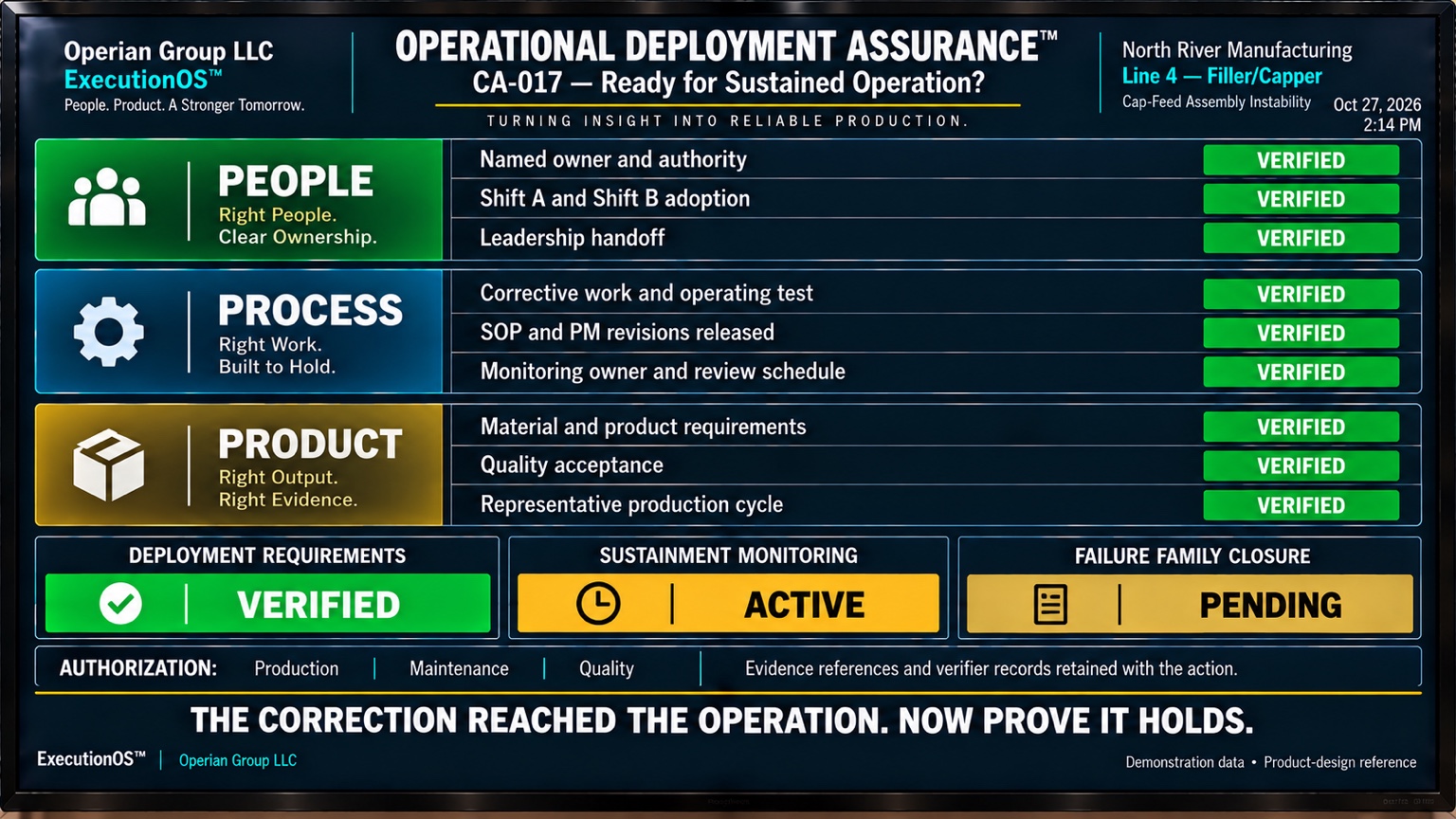
Operational Deployment Assurance brings People, Process and Product into one readiness review. It asks whether ownership is clear, all affected shifts adopted the correction, operating standards were released, and quality and production requirements were verified. Verified deployment starts sustainment monitoring. It does not automatically close the failure family.
Illustrative North River Manufacturing operating board. Demonstration data and product-design reference; not a customer result. This is Operian methodology across Product, Process and People — not a third-party certification.
Discuss an ExecutionOS Pilot